-
GIF Instagram Anxiety

The GIF is supposed to say “Me trying to act relaxed after posting on instagram”. Because a big source of anxiety for young people is waiting to be received by followers on instagram after posting a photo. Worrying about how many people are going to like it and whose going to comment can be a big source of emotional discomfort for my generation.
GIF made using http://makeagif.com/
-
A game of telephone: How technology changed the way we tell stories (10/17)
When you’re in elementary school, and the only source of technology that you have at your disposal is the phone that hangs on the wall in your kitchen, the art of storytelling was everything. My first real taste of storytelling was the game telephone. You sit in a circle, and one person has a word or phrase that they whisper to the person next to them, and that person whispers it to the person next to them, and so on and so forth, until you get to the last person in the circle and they say what they heard. Phrases like “I like Christmas” would turn into “My bike listens” between 10 kids.
Stories at that were such a. big part of my life. Having my dad sit on the edge of the bed, and work through the pile of books he said he’d read to me before it was time to go to sleep. And then when I got older and I could read chapter books by yourself. All these stories, being funneled into my brain verbatim, were interesting and wonderful, and when I would talk about them or try to regurgitate what I had read it usually came out pretty accurate, because there was no reason for them not to. Strangely enough, as you get older, and start tuning into what is going on outside in the real world rather than the one of The Magic Tree House or Harry Potter, it becomes more clear that the stories in the books were much easier to follow and regurgitate, because there is nothing not to trust. I distinctly remember one summer at camp, a professional storyteller came during recess and instead of play outside we had to listen to her. She had no notebooks, no posters, no materials at all, and she sat down and told me by far three of the best stories I had ever heard in my life. And she had made them all up on the spot, from beginning to end. When asked why she didn’t write her stories down or have anything to help her, she said that telling stories was natural to her, like eating and breathing. If she introduced the nuances of the digital world we were living in, she would taint her craft.
In middle school, I was introduced by a friend to Wattpad. It was this website where kids would go and write stories, and other kids would read. It was like an online book store, for free, where all the writers were teens and pre teens. Some people would upload a whole story, while others would upload a new chapter every week, or every two weeks. And the writers could gain followers and fans, they took requests for new chapters, new stories, even new characters. It was like a totally interactive publishing house that took out the middle man… the publisher. Readers had access to the author and the authors would write to the will and desire of the readers for the most part. It was amazing because it was like sitting down to watch a new episode of your favorite show every week.
I tell these stories to cushion my point which is that when you’re young, the best part about stories is that they’re 40% what you’re reading or being told, and they’re 60% your imagination. The movie playing in your head. And that’s enough, when you’re little that’s all there really is, your imagination. It propels you forward, the thoughts of what could be. In todays digital age, the art of the pen to paper has gotten lost. Movies, virtual reality, tik-tok, all of these and more have eliminated that middle man. The middle man being the imagination. Now you can hear about something, and then go and watch it two minutes later. There’s no more trying to imagine what the characters in the book look like, because the book is gonna be a movie any day now. What technology has done to the art of storytelling is take the intangible out of it. Anything that can be written down can now be created, nothings to elaborate or impossible. There is literally a movie for every single Harry Potter book. In a way, the imagination is gone, because it is hard to imagine something that’s right in front of you. What I mean by that is it’s hard to try and imagine Harry Potter not being Daniel Radcliffe. When someone had painted the picture for the world its not easy to paint it for yourself. It is almost as though we were all playing a big game of telephone, guessing, interpreting, imagining, and then they took out all the middle men and just made it a two person game. The writer, and the person who digitizes it, and all the imaginers and interpreters just sit and observe, because their jobs are being done for them. While this may seem dramatic, it’s real. I have a 7 year old cousin who reads books with an expectation of watching the movie directly after.
If you are fortunate enough to become the person who digitizes things that’s one thing, but for the masses that is unrealistic. Most of us are watching the trailers, not creating them. The digital age has cut the imagination out of storytelling for the masses.

Mother and daughter having story time!
Sources:
https://www.huffpost.com/archive/au/entry/how-cgi-changed-movies-forever_n_9155494
http://www.ted.com/talks/amanda_palmer_the_art_of_asking.html
http://www.wired.com/threatlevel/2011/01/hope-image-flap/
http://www.ted.com/talks/larry_lessig_says_the_law_is_strangling_creativity.html
-
The ever-changing digital age: literate today, illiterate the next
My mom graduated from Syracuse University in 1989, she was a communications major when technology was a burgeoning norm in everyday society. Technology companies like Apple were at the top of the cutting edge. The Macintosh Personal Computer had come out in ’84, but people didn’t really gravitate towards it. It wasn’t something that everyone had, and foreshadowing how people today approach new age technology, it wasn’t until people felt they needed it that it became popularized. So, back to my mother, as a senior in college she was focused on completing her senior thesis. During a conversation with her grandmother, she mentioned the paper and her grandmother excitedly invited her to her house for the weekend to work on her brand new Macintosh Personal Computer. She had been gifted it, but in her old age she had no use for it and it had been sitting in her attic. My mother apprehensively agreed to use the computer, strapped for time, and went to her grandmothers house with no expectation of finishing her assignment. To her surprise, the computer was easy to use, and she did finish the thesis. She was a computer savant. An original Macintosh Personal Computer circa 1989.
It is currently 2023, the Macintosh Personal Computer is a relic, and I am currently writing this article (and all my other ones) on a Mac Book Air that was released in September of last year. My mother carries her Mac Book Pro everywhere, she actually can’t do the work she does without it. That’s everyone though, right? Ever since I can remember, she’s had the latest technology. When I was in elementary school, she had a flip phone, the Macintosh Personal Computer (or desktop) lived in our basement, and her laptop went everywhere with her. Both pictured below.

As the years progressed, and technology evolved, so did she. She replaced the desktops as Apple came out with new ones, ones every other year she would come home with those big white bags with those chic white boxes inside holding a new laptop. And of course during this time she had a blackberry, because that was the hottest cell phone out. But then the iPhone took over, and the blackberry was out. The iPhone, the iPod, the iPod touch, the iPad, the iMac, they all entered the house and became… completely necessary.

So my dad completely doesn’t care about technology, he uses the oldest iPhone that Apple stores will sell and he uses it for calls and texts. Nothing more. For most of my high school career, he used one of my old mac books to do work from home, and when I was a senior we got him a brand new one that we spent an entire day teaching him how to use. He adapts with the times as necessary, and never anything more. He is as digitally literate as he needs to be. My mother, is very different, as you can guess she adapts as she sees necessary. But the technology that she has to adapt to is different than the 1984 Macintosh Personal Computer. Her iPhone runs out of storage, she’s in the store within the week getting a new one. Her computer crashes, within the hour she’s opening a chic white box taking the plastic of the latest model. She learns how to use it, and she utilizes it to its fullest potential. The modern woman. She believes herself to be literate and therefore she is.
Every year there is an entirely new line of technology, new technology to learn and master until the next thing comes out. So what does it mean to be digitally literate? Do you have to be 22? Do you just have to be willing to learn it? Most jobs require it. Under skills they say something like proficient in Excel, Adobe Premiere Pro, etc. How does one make a living, an independent living, without being digitally literate. Farming? Living as a Nomad? To be literate has a spectrum of meaning based primarily on what you want to do with that literacy. As time has gone on, it’s become increasingly pertinent and necessary to be digitally literate.
Citation:
Jony Ive’s Design Legacy at Apple
https://www.theguardian.com/technology/2016/dec/04/google-democracy-truth-internet-search-facebook
-
What social media does to social life.
As a 20 year old girl in todays society, the social media is more than just a way of communicating. Social media = life. In the least dramatic way possible, social media is everything. In the TED talk “the tribes we lead”, Seth Godin talks about how in todays age of the social media empire, and anyone being able to attain one, we often forget how easy it is to start a movement. He goes on to talk about how a movement today is so unlike a movement was before the popularity of social media. You don’t have to have the ear or the eye of everyone, but you just have to get the attention of the people who are just as passionate or excited about your cause as you are and then your movement has begun.
TED Talk: The Tribe We Lead by Seth Godin I can recognize the positivity in this, being able to promote change in such an accessible way. But, I also have to be honest when I admit that this can also be really dangerous. I feel like movements are often talked about exclusively under the guise of positivity, but there is a darker side to this that can be exacerbated by the accessibility that social media gives it. The overall premise of the TED talk is anyone can start any movement for anything. The Black Lives Matter movement is a prime example of how this can be positive and a negative. Over the pandemic, BLM grew into a worldwide movement spawning from the death of George Floyd. While the entire world was on lockdown, millions of people rocked their lives to march and fight for the rights of black people. Social media was the catalyst for this movement. (Sidenote: I also feel like in a way this is an example of how social media will never go away, because the minute everyone was forced inside and there was nothing to post about, nothing to really share, people started posting more, snaring more, and then George Floyd died and social media was back and had a stronger presence than ever). Without social media, there wouldn’t have been a fraction of the change that we saw come to fruition. But, there was also a performative aspect to the movement. White people being intentionally antagonizing to gain recognition, people looting and destroying and taking video of it. All encompassed together the movement had direction and purpose, and served the greater good, but this was an example when a mass movement propelled primarily through social media.
Organizations that perpetuate negative hateful ideals and concepts like white supremacy or anti-semitic, gun lobbyists, pedophiles, etc., are also allowed to share and grow through social media as well. The internet is always perceived as such an open space that exposes people to everything, and vice versa, but the flip side of that theory is the fact that as the internet developed it has become just as private and accessible as it is public. What I mean by this is these groups, knowing that they are culturally unacceptable, but still have a following, use the internet as a means of communication. However, the means in which they use the internet is such that it isn’t something that someone who is not looking for it or invited to it can access therefore it is private.
SOURCES:
Home
Social Media Use Continues to Rise in Developing Countries but Plateaus Across Developed Ones
https://iop.harvard.edu/iop-now/how-millennials-use-social-media
http://archive.pressthink.org/2006/06/27/ppl_frmr.html
http://www.theatlantic.com/technology/archive/2015/04/the-truth-about-black-twitter/390120/
http://www.economist.com/node/18904124
https://childmind.org/article/how-using-social-media-affects-teenagers/
https://www.ted.com/talks/seth_godin_on_the_tribes_we_lead
https://www.wbur.org/hereandnow/2014/02/10/black-twitter-dissertation
-
Your self…ie?
At an HBCU something that is a very prominent aspect of the culture is your brand. Your personal brand is everything, or at least it can feel like it is. But a big part of your personal brand is your face, facial recognition, people being able to not only look at you and know what your about, but know what your about and think of you when they see something that aligns with it. It is hard. The shift between what social media, specifically the selfie, means to people as they get older is drastic. However, the context of the selfie has always been so casual, but personal, and the juxtaposition of those two traits add a certain vexing quality to the selfie as well.
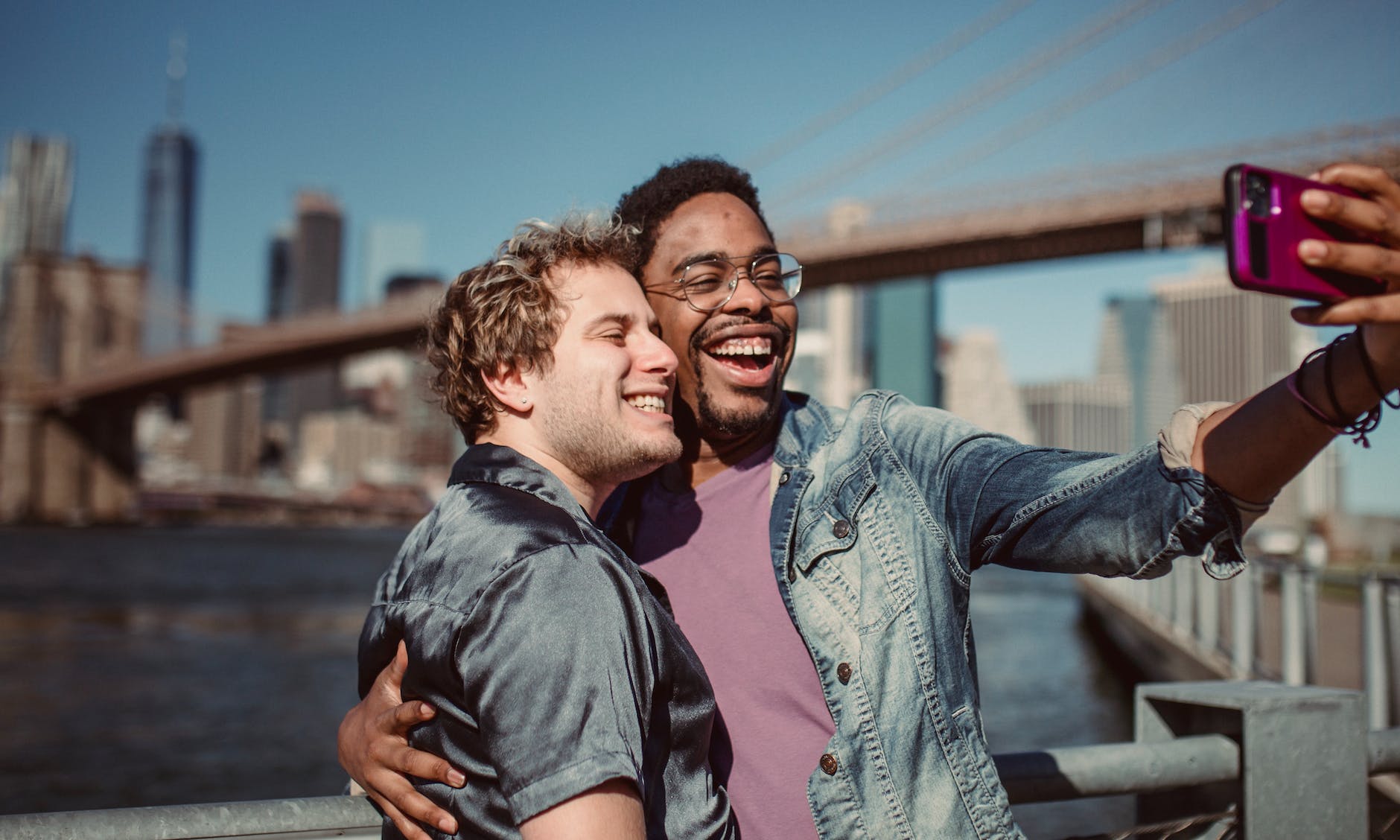
Photo by Ketut Subiyanto on Pexels.com In a second, you can share a piece of yourself with. the world. In a literal sense. But the psychological aspect of it is also deeper than it seems. A popular saying is “no one’s harder on you than you are on yourself”. But the selfie takes it to an entirely new level. Best case, you are the worlds most confident individual, and taking a selfie is nothing but taking a selfie. But, for the a lot of people, selfies are an actual source of stress and anxiety. The represent how you see yourself, but they also represent how other people see you.
Get Comfortable with Being Uncomfortable TED Talk The intensity around the selfie may seem dramatic, and it is, but in the age of social media the heightened need for validation by others has made things… dramatic. Recently, Gen Z has been really trying to push against the societal norms and standards that have been set up by social media. Specifically, the pressure that social media has put on us as young people, and that we have put on ourselves. What the selfie represents at this point is both the beginning and the end of the age of self absorption and perfection. And as a generation, we are adjusting to the feelings of discomfort we feel around the normalcy of imperfection.
Sources:
Me, My Selfie & I – The Rise of Selfies & How Businesses Are Using Them
https://childmind.org/article/how-using-social-media-affects-teenagers/
http://gary.tumblr.com/post/78887853/legacy-is-greater-than-currency
-
Vogue.com-the most addicting site in the world
The first thing that comes to mind when I think of Vogue is the logo. Whoever the Vogue brand manager is would probably be ecstatic hear that. The big black letters with the white background is one of the most recognizable logos in the world.

(Iconic Vogue logo)
Vogue is indestructible because it happens to be the millennial representation of the new founded “American Dream”. Not the Of Mice and Men version, but the version where anyone can be famous and celebrity which is only bestowed upon 1% (give or take) of the human race, is attainable by anybody.
The multimedia empire that is “Vogue” has created a brand entirely centered around aspiration. This could be perceived as not very inclusive, because that concept of aspiration creates an audience of only upwardly mobile individuals. People who “can” aspire because they have the means, or the potential means, to do so. What is interesting about this audience is that it ranges. Anybody from a high school student to Kim Kardashian can be considered an aspirer. However, not everybody is. So why is Vogue.com still here? Obviously its iconic, right? But iconic doesn’t buy magazines or click on the links. Vogue.com is still here because Vogue is considered (by all the aspirers) to be a cultural taste maker. When you are considered to be the creator, your reliability is indisputable. Because Vogue itself has such a strong brand of not just being culturally relevant, but culture (period), the news that Vogue.com publishes is thought of on the same level. Unfortunately, there are few other news outlets that have that level of reputation.
It would be hard to “cancel” Vogue. So, I guess their business strategy is almost impossible to re-create. On top of that, I think Vogue knows this. So they make almost certain that the majority of the pieces they put out are “opinion” pieces and interviews. They have journalists who are columnist style writers, interviewers, writers with interesting and distinct voices, and use that to keep things interesting. But they also outsource to celebrities and famous people, because even though the internet is the most popular source of information, the information people want to know about is more often than not about celebrities, the rich and famous. So why not get Florence Pugh or Zendaya to write an article, and be interviewed for one, and be on the cover, because that is what readers want. It all ties back to the idea of aspiration. According to Forbes, the second most thing that people desire and cannot attain is money. Tapping into the unattainable, and showing it off to those who can’t attain it, and even suggesting that maybe one day they can, is one of Vogues most profitable business plans.
SOURCES:
http://www.tandfonline.com/doi/pdf/10.1080/21670811.2012.740273
https://www.newsweek.com/fake-news-poll-americans-fact-opinion-reading-news-stories-984095
https://today.duke.edu/2020/08/navigating-fake-news-how-americans-should-deal-misinformation-online
https://digitalcommons.usf.edu/cgi/viewcontent.cgi?article=1001&context=oa_textbooks
-
The Almost Totally Interconnected Universe (9/18)
A network is a means of which we interact and exchange some form of information with others. It is also a means of which we gather information. I think that the accessibility to information that we are given by networks is astonishing. In the digital age that we live in, networks are essential to the average persons every day life. Being able to have information, not only from multiple different sources, but with multiple different levels of accuracy, is something that has become an integral part of society. Recently, the Queen of England passed away. I am not all that invested in the royal family, and I don’t keep up with them, I found out about the queens death within the minutes of it happening as well as the world.

This is the symbol for interconnectivity.
Above is the symbol of interconnectivity
The ability for trans continental communication has become so normalized. Furthermore, any countries that have yet to catch up to the digital age of today is seemingly not recognized at all, they’re “inconsequential” and irrelevant simply because of the fact that they are not able to continuously share and exchange or receive the information of the world in the way that has now become the only way imaginable. I also think that it is phenomenal the rate at which networks have integrated themselves into the lives of the majority of the population. My mother who is 52 years old relies on her computer and her cell phone to keep up with her business. She wasn’t even introduced to computers until she was in college writing her dissertation, and now it is one of her primary weekday accessories. Companies like Apple, Inc. and Microsoft have made billions of dollars off of the singular concept of having a machine that through networks will allow you to know anything, communicate with anyone, and see everything you want within seconds. Without networks, the idea that the world is such a small place would be obliterated in seconds. That concept only exists because we are so privy to happenings all around the world through the media and nothing else.
SOURCES:
https://www.britannica.com/topic/media-convergence
https://www.scientificamerican.com/article/long-live-the-web/
http://www.albinoblacksheep.com/flash/epic2015
Optional: Computer history timeline: http://www.computerhistory.org/timeline/?year=1994
http://www.vanityfair.com/culture/features/2008/07/internet200807
-
9/5 Reflection Post
The reading from the Student Press Law Center outlined the rights that students who participate in Journalism, both on and off campus, have and how to protect their journalistic integrity. I thought it interesting that the scenarios given by the article seemed outlandish and a little absurd to me. I think that just speaks to the level of journalistic opportunity I have been afforded over the years. Maybe it speaks to the level of education I have been given, but I’ve never really had to worry about being censored, or what I can and cannot say when it comes to my writing. Todays youth is much more opinionated, and I feel like todays culture really advocates for going against what might be thought of as “traditional authority”. I also feel as though adults in those positions of power aren’t as inclined to enforce that level of authority because of cancel culture and its unpredictability. Something interesting that the article also touched on was the idea of defamation, and what separates defamation from an opinion. Interestingly enough, the determinant of defamation is less so in the wording and more in the information shared than anything else. However, defamation itself is a bit harder to actually be sued for. You have to be actively spreading lies about someone, horse realities or critiques do not count. Similarly, when it comes to publishing articles and stories online with an added comment section, the publishing party is not legally responsible for anything that the public may have to comment on the piece. I also found it interesting that while at public institutions (both secondary school and collegiate institutions), regardless of who funds the student publication (student paper, radio station, etc), it is in direct violation of the first amendment. However, the same cannot be said for private institutions. What differentiates the two was not specified, but it can be assumed that it is because of the funding that each respective institution receives and from whom they receive it. All in all, the reading outlines what all student reporters should know and how they should conduct themselves when it comes to their reporting, who can and cannot sensor them, and what they should watch out for when it comes to abiding by their first amendment rights and not abusing them.
-
Hello World!
Welcome to WordPress! This is my blog. I’ve filled it with my thoughts, and my assignments. I’m learning how to use this, so give me a minute.
-
Subscribe
Subscribed
Already have a WordPress.com account? Log in now.
 Intro to Digital Media Literacy